Thursday, May 22, 2014

Benton Lake National Wildlife Refuge, Great Falls, MT

May 22, 2014
I'm falling a little behind on the blog. We've been in Glacier NP for the last four days and haven't had a minute to write. On our way to Glacier, we spent two nights in Great Falls, MT at Dick's RV Park. It was nothing fancy, but was run by friendly people and was conveniently located near a paved cycling/running path along the Missouri River. And besides, it was time to catch up on laundry!

While we were there, we decided to take a drive to the Benton Lake National Wildlife Refuge. We were surprised to find a wide variety of birds, some that we had never seen before. To me, that's one of the best things about traveling around the country. I love seeing new and different wildlife.

There's a loop road running through the refuge, winding through fields and around a large lake. Here are some photos of the ones I was able to capture. If you click on the image, you can enlarge it.


I think this is a Western Meadowlark. It looks like a pretty young one.

This is a Marbled Godwit. I also saw this one in South Dakota earlier on our trip. This is a better example.


Yellow-headed Blackbirds were abundant in this refuge. Last time I tried to snap a photo of this bird, it didn't cooperate. This time was different!


A few different varieties of ducks were there. These (right and below) are Cinnamon Teals. The one on the right is the male. Below are the male and female. No, he's NOT trying to drown her!


These are a pair of Shovelers. Looks like a lover's quarrel to me!


 This is a Solitary Sandpiper.
 This is a pair of American Avocets.

This is either a Glossy Ibis or a White-faced Ibis. I'm not sure. It's feathers were iridescent--really beautiful!


And last, but not least, here is a White Pelican. Notice the bump on its beak. This apparently only appears during mating season.


If I've misidentified any of these, please let me know.

Next blog will be about our stay in Glacier NP, both east and west. We head into Canada tomorrow, so we'll have to rely on public access wifi for awhile until we get to Alaska and can use our own hotspot.

Monday, May 19, 2014

Stops along the road

As we traveled from the Black Hills to an overnight stop in Buffalo, WY we took a side trip to see the monolith made famous by "Close Encounters of the Third Kind", Devils Tower.
Devils Tower was the first declared United States National Monument, established in 1906, by President Theodore Roosevelt.

There are several competing  theories as to whether Devils Tower is an igneous intrusion, a laccolith or a volcanic plug. In any case it's an impressive rock rising 1267' above the surrounding terrain.

The tower can be seen for miles in all directions.


There's a paved trail around the base that is 1.3 miles long. Of course, if it's a hike, we're gonna do it.

The tower is a favorite for climbers but because of nesting Prairie Hawks they couldn't climb this side.


But they could climb this side. Other than the guy soloing in the center there are two more climbers in this picture. Can you find them?
Note: The soloist is resting with his climbing shoes off!

Saturday, May 17, 2014

Crazy Horse Memorial


We visited the Crazy Horse Memorial on Wednesday morning. We thought we were going to pop in and pop out, but we ended up staying for a couple of hours. I hadn't been there since 1978, and it was interesting to see the progress. There were photos on the wall showing progress over the years. The project started in 1948. The photo that was closest to the year I was there was for 1982. Here's what it looked like then. An incredible amount of rock had to be blasted away before any actual features could be sculpted.


Here's what it looks like today.

The face was completed in 1998, the 50th anniversary of the project. 


Now they're working on the outstretched arm. The painted white outline is a sketch of the horse's head to give an idea of it's position.

One of the challenges of this sculpture, and a big difference between it and the Mt. Rushmore sculpture, is that this one is going to be 3-dimensional. Here's a view of the back side. They haven't started to carve this yet. 


The progress is slow for many reasons. There is no room for error when blasting away rock, so the work is done very carefully. Funding for the project comes solely from paid admissions (which now are $11) and private donations. 

For another $4, you can take a short (5 minute) bus ride to the base of the sculpture to get a close up view. This is the only money that the family collects from visitors. All other admission money collected goes to the Foundation for the completion of the project. The sculptor, Korczak Ziolkowski, and his wife Ruth, dedicated their lives to this sculpture. When Korczak passed away, Ruth took over the management of the project. They had ten children, seven of whom are still working at the site today and are committed to the completion of their father's work.

A scale model of the completed sculpture is on display on the veranda of the visitor's center which overlooks the mountain. Here is what the sculpture will ultimately look like.


Here are the dimensions of the Crazy Horse sculpture along with comparisons to other sculptures and structures. It will be the largest sculpture in the world.


The face on the mountain is a very good likeness of the sculptor's model.


In addition to viewing the sculpture on the mountain, you can view a short film giving some background into the artist and the project, the artist's home and studio, and several rooms of exhibits of Native American history and culture. 


Friday, May 16, 2014

The home of Rocky Raccoon (The Black mining hills of South Dakota)

On Monday we took a short 90 mile drive from Badlands NP to Rapid City, SD where we planted ourselves in the Rushmore View RV Park. It was an interesting departure from the flat grasslands of the Badlands to the up and down of the Black Hills.

We took the scenic Rt. 44 south of the Badlands rather than US 90 for an easy drive with literally no traffic. 


What a change from the straight flat Rt 44 above to the up and down hairpins of the Black Hills.


After getting settled our first order of business was to find Mt. Rushmore.
The Mt. Rushmore monument was originally  conceived as a tribute to western hero's such as Buffalo Bill, Annie Oakley and others. Gutzon Borglum was hired as designer and sculptor but thought that the monument should be to great American leaders, thus, Washington, Jefferson, Roosevelt and Lincoln.
The promenade has the flags of all 50 states displayed.


Viewing the monument from the promenade is spectacular.....


.....but viewing it from the walkway directly below the faces allows you to see incredible detail like Roosevelt's pince nez glasses and Lincoln's beard.


On Tuesday we headed out to Custer State Park via the Needles Highway. The NH is incredibly twisty with many 180 degree hairpins and radical elevation changes, Along the highway are the "Needles", granite fingers sticking straight up.

There are also numerous tunnels like this one that is 8'6" wide and 12' tall and had a forty foot bus going through it!


Some areas were so narrow I had to take the truck through verrrryyy slowly. (I don't know how the bus got down the road but it must have been exciting for the passengers)


On the other side of the park is another twisty, turny road, Iron Mountain Road. The road was laid out from horseback by the former SD governor Peter Norbeck. There are 3 tunnels on the road that have been oriented so that, when travelling north, you have a view of Mt. Rushmore from the entrance of each tunnel.


Also, on this road, were "Pigtail Bridges" so named because they handled elevation changes by turning 360 degrees with the exit passing under the entrance (downhill). They were engineering marvels whose spans were constructed of wood. Check it out.


 That's all for now. We'll be on the road for a few days but are planning stops at Devil's Tower and Little Bighorn. 

Custer State Park in the Black Hills of South Dakota

May 14th and 15th

Custer State Park is a 71,000 acre park with three distinct landscapes. The sections are connected by three scenic roads--the Needles Highway, the Wildlife Loop Road, and Iron Mountain Road.

The Needles Highway is the highest section with winding roads and granite spires. It's also the coldest section. Note the snow still on the ground!


The Cathedral Spires are the most famous rock formations in the Black Hills.


This rock formation is called the Needles Eye, so named for obvious reasons.


We saw mule deer wandering in the forest along the Needles Highway.


The Wildlife Loop Road is open rolling grasslands. The 1,300 buffalo roam freely throughout the park, but are most often seen in this area. They move quickly, so you never know when or where you'll spot them. I was told by a ranger that they can sustain a 30 mph pace for an hour! They move at about 5 mph while grazing.


This group started out far back in the field, and before we knew it, they were just a few feet from our car!


It's a bit disconcerting to have a buffalo staring at you at close range!


We were lucky to get to see lots of buffalo calves too.


Other animals along the loop were elk,


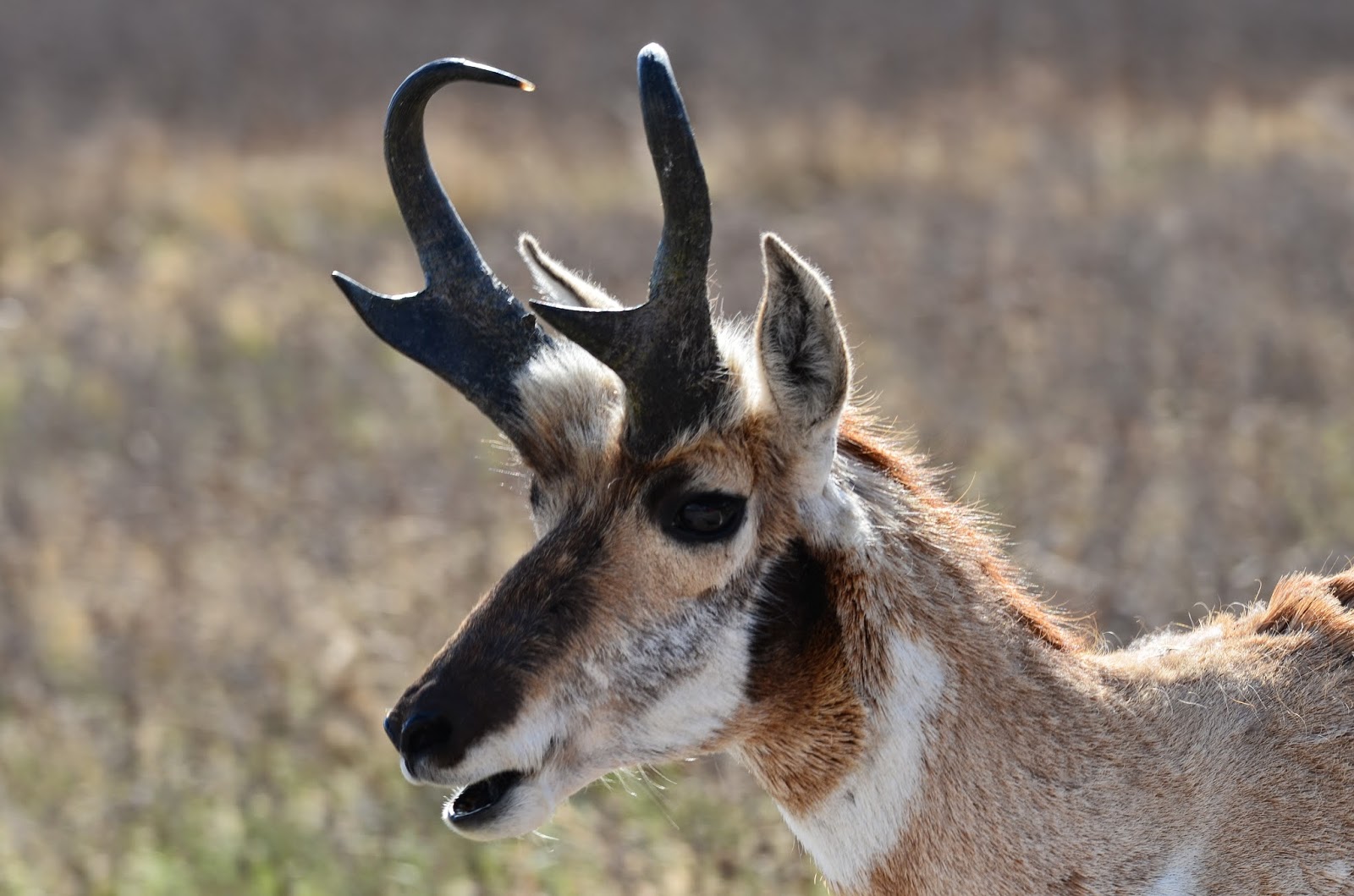
pronghorn antelope,


and, of course birds!


Here are a mountain bluebird


and a chipping sparrow.


There were unpaved roads to explore also, so of course, we took them!


The third section of the park was the Iron Mountain Road, winding through pine forests.


There were several tunnels along this section of road, and they were well planned so that when you passed through the tunnel, you could see the faces on Mt. Rushmore.


I highly recommend visiting this area if you're ever in South Dakota!